[ITA]
A Brief History of Libreria Utopia in Milan 1977–2000
by Elena Petrassi
Background
In the 1960s and 1970s, a group of young anarchists – known as Bandiera Nera – was active in Milan, running two political centers: the Circolo Ponte della Ghisolfa (in the north) and the Circolo Scaldasole (in the south) – and carried out militant activities that, over time, ranged from “provos” practices to grassroots workers’ committees, from student assemblies to the anti-Francoist struggle. The Milanese group, a member of the Federated Anarchist Groups – one of the three italian national federations in existence at the time – was at the center of all the dramatic events that marked Italian history in the late 1960s. In fact, they were unwittingly drawn into the so-called “strategy of tension” – a series of terrorist attacks carried out by neo-fascist groups in collusion with the Italian secret services – which culminated (though not concluded) in December 1969 with the Piazza Fontana bombing in Milan and the murder, during a police interrogation, of railway worker Giuseppe Pinelli, a member of Bandiera Nera. This was followed by an intense counter-information campaign, carried out in collaboration with many other political and social forces, which succeeded in overturning the accusations, to the point that that terrorist attack has gone down in history as a “state massacre.”
It was precisely in the context of that relentless counter-information campaign that the first of the publishing and cultural initiatives founded by the Milanese group came into being: the monthly A rivista anarchica (1971–2020), which, throughout its half-century of existence, would remain the most widely circulated Italian anarchist publication. Following the magazine, the same group launched various publishing and cultural initiatives throughout the 1970s, all the while always engaging in their militant activities: the Italian editorial management of the international journal Interrogations (1974–1979), founded in Paris together with Louis Mercier Vega ; Edizioni Antistato, “inherited” from Pio Turroni, which was followed in 1986 by the publishing house elèuthera, still in operation today; the Centro Studi Libertari/Archivio Giuseppe Pinelli, founded in 1976 and still active today; the magazine Volontà (1946–1996), founded after World War II by Pio Turroni, Giovanna Caleffi Berneri, and Cesare Zaccaria , and edited by the Milanese group from 1980 to 1996.
Together, those young anarchists had learned “out of necessity” to write, translate, layout, and proofread (and, for the Pinelli Archive, to archive and catalog): a militant calling that, over time, would also become a profession for some of them.
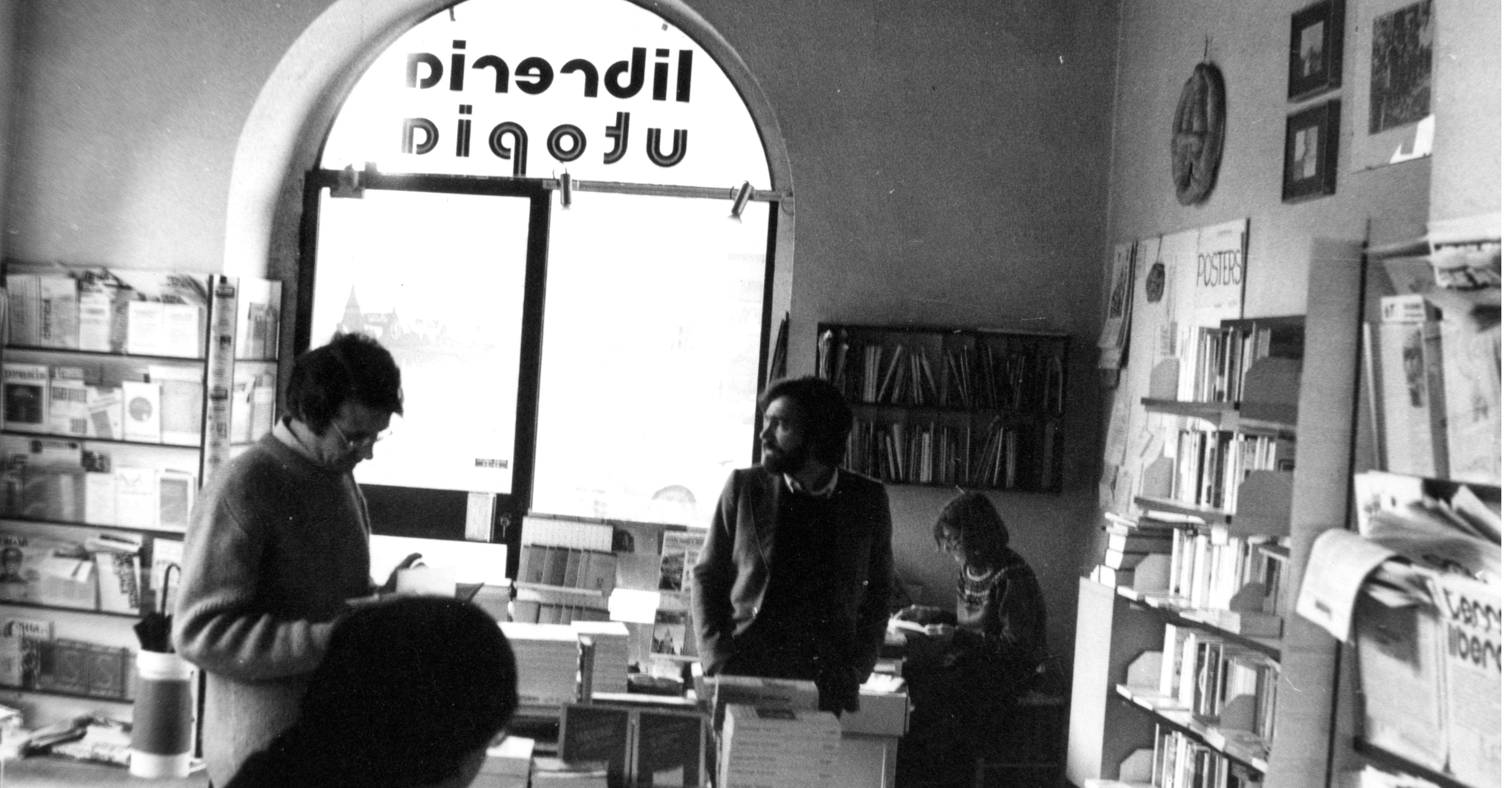
The Birth of the Bookstore
Amid this flurry of activity, one member of the group – Fausta Bizzozzero, one of the comrades who loved books the most – began to think that what was needed was not “political” meeting places, but rather a space open to the public where people could discover the many newspapers and books through which anarchists circulated their ideas, opening themselves up to dialogue. So, in 1976 – together with Luciano Lanza, her partner at the time and also a Bandiera Nera member – she decided to open a bookstore despite the many hindrances (primarily financial and bureaucratic).
Neither of them had any experience as a bookseller (both worked in administrative roles). The rest of the group, though not directly involved in the initiative, showed interest in the creation of a bookstore, which was named Utopia. The “place that does not exist” had always fascinated Fausta. Although it was a concept difficult to define and confine to a specific framework, it was at the same time a word that invited one to imagine, to mentally explore different worlds, different relationships, and different societies – as all literature (not just science fiction) demonstrated.
The chosen premises – two floors, one of which was a basement, and five storefronts facing the street – were located at the corner of Largo La Foppa and Via della Moscova, in a central area of Milan. The previous business had been a deli that had left behind a large brine tank in the basement, along with an oily film covering all the walls. But the historical origins of that traditional shop were quite remarkable: at the end of the 19th century, the site was home to Caffè Aurora, a popular café frequented by Milanese subversives, in front of which – not coincidentally – violent clashes took place during the uprisings of May 1898, when dozens of protesters were killed by cannon fire from royalist troops (the infamous Bava Beccaris massacre). To avenge this massacre, the Italian anarchist Gaetano Bresci would assassinate King Umberto I of Savoy two years later, returning to Italy specifically for that purpose from Paterson (New Jersey), where he worked as a weaver.
The spirit of the place was therefore already revolutionary, and Fausta and Luciano were revolutionaries in pursuing their dream of opening Milan’s first anarchist bookstore. Both quit their respective jobs, and in February 1977 the bookstore opened its doors, to be officially inaugurated the following April.
___________________________________________________
OPENING PRESS RELEASE
On Saturday, February 26, the “Utopia” bookstore opens in Milan – a large libertarian bookstore specializing in: economics, sociology, history of the labor movement, pedagogy, feminism, fiction, classics of anarchist and libertarian thought, anarchism and libertarian movements today, and French, English, German, and Spanish anarchist and libertarian books.
One section of the bookstore is dedicated to records: classical and chamber music, jazz, free-folk-pop, and anarchist and protest songs.
Also available are magazines on culture, economics, psychology, sociology, and music; publications from the revolutionary left and underground movements; and anarchist magazines and newspapers from around the world.
The bookstore also aims to serve as a cultural center by hosting meetings, conferences, debates, and book and record presentations.
UTOPIA BOOKSTORE - VIA MOSCOVA AT THE CORNER OF LARGO LA FOPPA
OPENING HOURS: TUESDAY THROUGH SATURDAY FROM 9 AM TO 12:30 PM – FROM 3:30 PM TO 7:30 PM
TRAM/BUS 8 - 33 - 52 - 61 - 70 - 97 - MM2 GARIBALDI
___________________________________________________
Becoming Booksellers
There were at least two aspects that the new booksellers had underestimated when embarking on this adventure: their lack of professional training – because you can’t just wing it as a bookseller – and the impact that the traditional image of anarchists continued to have on their potential audience, given that the mainstream imagination was dominated by the idea of anarchists as brutes and bombers.
In fact, the bookstore itself was the target of a violent attack in 1978 – a turbulent period in Italy marked by the convergence of the “strategy of tension,” orchestrated by powerful forces in collusion with subversive fascist foot soldiers, and the armed struggle waged by certain revolutionary groups, the most famous of which was the Red Brigades (a dogmatic-communist faction). No one ever claimed responsibility for the attack, but according to Fausta, it was of fascist origin: “unknown assailants” drove past the bookstore, firing at the five display windows and cracking them (given the times, the glass was wisely bulletproof). Fausta was with a customer to whom she was playing a record. Both threw themselves to the ground, taking cover behind the record shelf. Shortly afterward, a second group passed by and this time threw Molotov cocktails, sparking a small fire that caused no damage to the bookstore or its occupants. Business continued undisturbed.
Within a couple of years, Luciano Lanza realized that this wasn’t his calling and began working as a journalist specializing in economics, though he continued to contribute to Utopia’s cultural activities. Tiziana Ferrero-Regis and Dario Bernardi, two members of Bandiera Nera who had participated in the project’s early stages, also went their separate ways. Thus, what had begun as a small group of like-minded people intending to collectively manage the bookstore transformed into a primarily individual initiative, even though various people (notably Ettore Zottele and Mauro Decortes) would work at the bookstore for varying lengths of time.
Fausta, in fact, doggedly carried on with the project, even taking on other jobs at night to make ends meet and pay the bills at the end of the month. So she began freelancing as a translator, layout designer, and coopy typist. Only with this additional income did the bookstore – which for a few years was joined by Libreria Utopia 2 in Venice and Libreria Utopia 3 in Trieste, whose stories have yet to be told – manage to survive, becoming, moreover, a well-known and highly regarded cultural space even outside anarchist circles.
The Business Side
In the early years, Fausta would make daily trips to the warehouses of various book distributors, returning each time with four extremely heavy sacks of books. Then, over time, the bookstore became a full-fledged part of the commercial book circuit, adapting in some respects but remaining an outsider in others. In fact, different publishing worlds with different rules coexisted on the bookstore’s shelves. And the very layout of the premises attested to this diversity. The first room housed fiction, produced mostly by commercial publishers; the second was dedicated to nonfiction, where anarchist texts – both Italian and foreign – predominated; while the third featured books for children and young adults. This three-part division was also reflected in the three display windows facing the main street, while the remaining two display doors showcased a selection of new releases (fiction on one side, nonfiction on the other).
These diverse editorial approaches were, however, united by two binding criteria: the quality of the content and the editorial work (which penalized the mass market, leaving more room for small publishers and self-published works) and compatibility with an anti-authoritarian worldview in the broadest sense, and always pluralistic (to the point of sometimes appearing contradictory, even). These two criteria required an in-depth and constantly updated knowledge of the bookstore’s offer – books, but also records, newspapers, comics, fanzines… – and of the publishing histories behind them.
This was not the only effort required, either, because the coexistence of these different publishing worlds demanded different “business” approaches. So while part of the inventory fell within the workings of an increasingly centralized book market (the very workings that are now leading to its collapse…), a considerable portion of the inventory involved direct relationships with a myriad of micro-publishers: an immense undertaking that entailed considerable costs in terms of time and energy. Though these costs were unavoidable, if the goal was to preserve and promote a truly pluralistic offer, as Fausta well knew.
One final aspect – of a business nature, in its own way – concerned theft. Especially during the first ten years of operation, thefts were constant and substantial. Obviously, there were no security measures of any kind, nor were there any supervision. And after a while, word had even spread in certain circles that stealing from Utopia was easy and safe because the anarchists would never report anyone… Which was perfectly true. Moreover, there were several instances of people caught “red-handed”: some, feeling ashamed, returned what they had taken; others justified their actions by citing a state of necessity (usually penniless students); and finally, some openly claimed responsibility, citing more or less convincing ideological reasons. No one was ever reported to the police, attacked, or reviled, and after a few years the phenomenon subsided on its own and stabilized at levels that could be considered “normal” (the reason is unclear: perhaps because, in the meantime, books were becoming an increasingly less appealing medium of communication).
Cultural Activities
While the ground floor of the bookstore was entirely occupied by bookshelves, the basement – where the brine tank once stood – had been transformed into a hall for presentations and debates. And it was this intense cultural activity that – after the initial wariness toward the “fearsome” anarchists – made the bookstore a hub not only for the neighborhood but for the entire city. The underground hall – which, in fact, had all the hallmarks of a subversive lair – did not limit itself to hosting conventional book presentations but became a meeting place for students, teachers, associations, and study groups… And while the business management of the bookstore had, out of necessity, become a one-woman operation shouldered by Fausta, the lively and multifaceted cultural side always remained a collective endeavor. Hundreds of initiatives took place over the years, covering a wide variety of topics ranging from politics to economics, from philosophy to literature. Gradually, the book presentations – which had initially been the main focus – were increasingly complemented by structured series of meetings that – unsurprisingly – often addressed themes related to anarchism, especially contemporary anarchism.
However, anthropology also played a prominent role in these cycles. After all, it was one of Fausta’s great intellectual passions; together with, Tiziana Ferrero-Regis, Maria Teresa Romiti, and Elena Petrassi, she had formed a collective of “armchair anthropologists” – as they liked to call themselves – which the late Paolo Finzi, the driving force behind A rivista anarchica, ironically christened Le Scimmie (The Monkeys). That name was later adopted, just as ironically, by the all-female group, which went on to carry its activities over a decade (from 1983 to 1993). Inspired by the works of Pierre Clastres, Le Scimmie focused their studies on stateless societies and the mechanisms of power that governed them, regardless of gender or women’s issues. So much so that in 1983 there was a very heated clash with the feminists of the “theory of difference” current, who were based at the Libreria delle Donne in Milan. For Le Scimmie of the Utopia Bookstore, changing the gender of those in power would not have altered the substance of that power, and for these anarchists, this was unacceptable. A heated debate ensued, which i highlighted the divide between difference feminism and anarchist feminism in Italy.
The end of a 23-year-long story
While in terms of its significant cultural impact Milan’s Libreria Utopia was the result of the energy and creativity of many, it is certain that as far as its “physical” existence is concerned, it would not have lasted so long without the will, determination, and expertise of a single person: Fausta Bizzozzero. But no matter how strong one’s personal convictions may be, one must still come to terms with the world as it is… Over the course of its 23 years in business, the entire world surrounding this “island of utopia” changed, including the strategies of the publishing giants – stronger-by-day monopolies vying with one another for “market dominance” – which are now swallowing up (or crushing) the entire supply chain, from small publishers to independent bookstores. And it doesn’t end there: the Garibaldi neighborhood itself – where the bookstore was born and raised, home to Caffè Aurora – underwent profound changes during the decades spanning the late 1970s to the 2000s, transforming from a working-class, bohemian neighborhood into a gentrified area where trendy venues are multiplying, driving out artisan workshops and independent bookstores. This social and cultural shift inevitably affected Utopia as well.
And so this beautiful story of passion and ideals came to an end. For reasons that were partly personal, Fausta sold the business to others in 2000, and the bookstore lost its anarchist character, transforming into something else, only to close its doors for good a few years later.
Sources
Fausta Bizzozzero’s personal archive: written memoirs, interviews, brochures, and flyers
Elena Petrassi’s personal archive: brochures, audio cassettes, notes
All documentation has been donated to the Centro Studi Libertari/Giuseppe Pinelli Archive and is currently being cataloged.